

MBTI vs Zodiac: What’s the Difference? (And Why Combining Both Can Give You New Personality Insights)
If you have ever taken a personality test or read about your zodiac sign, you may have noticed that both systems describe recognizable patterns in how people think, feel, communicate, and relate to others.
You might be an analytical INTJ who also identifies with the ambition traditionally associated with Capricorn. Perhaps you are an enthusiastic ENFP who relates to Sagittarius themes of curiosity and exploration. Comparisons like these naturally raise questions about MBTI vs zodiac, whether the two systems are connected, and whether one is more accurate than the other.
The most important distinction is that they come from different traditions. The Myers-Briggs Type Indicator is a psychological personality framework. Zodiac personality comes from astrological symbolism connected with birth dates and celestial traditions.
They are not interchangeable, and one cannot reliably predict the other. However, many people enjoy exploring both as separate tools for reflection. This guide explains what MBTI is, what zodiac personality means, how the systems differ, and why combining them can offer fresh questions about identity without proving anything about who you must be.
Why People Compare MBTI and Zodiac
People have always looked for language that helps them understand themselves. Modern personality frameworks organize recurring preferences into recognizable categories, while astrology uses symbolic archetypes associated with signs, planets, and traditions.
Today, these interests often overlap. Online discussions regularly ask which MBTI type resembles each zodiac sign, whether INFJs are commonly Pisces, or whether Aries personalities tend to be extraverted.
These comparisons can be entertaining, but MBTI and zodiac are not competing versions of the same system. They use different methods, describe personality in different ways, and serve different purposes. Understanding those differences makes the comparison more useful.
What Is MBTI?
The Myers-Briggs Type Indicator is one of the best-known personality frameworks. Katharine Cook Briggs and Isabel Briggs Myers developed it during the twentieth century, drawing inspiration from Carl Jung’s ideas about psychological types.
MBTI does not measure intelligence, talent, mental health, or moral character. Instead, it describes preferences in how people tend to direct their energy, process information, make decisions, and organize their lives.
The framework uses four preference pairs. Together, they form 16 possible personality types.

Extraversion and Introversion
Extraversion and Introversion describe where people often direct their attention and restore their energy. Extraverts generally gain stimulation through external activity and interaction. Introverts often prefer reflection and quieter environments.
These are preferences, not absolute rules. Introverts can be sociable, and extraverts can enjoy solitude.
Sensing and Intuition
Sensing and Intuition describe how people tend to gather and interpret information. Those who prefer Sensing often focus on direct observations, practical details, and present realities. Those who prefer Intuition usually pay more attention to patterns, possibilities, and future implications.
Thinking and Feeling
Thinking and Feeling describe common decision-making priorities. Thinking preferences emphasize logic and consistency. Feeling preferences place greater emphasis on values, relationships, and the effects of decisions on people.
Both involve reasoning. The difference lies in which considerations tend to receive greater weight.
Judging and Perceiving
Judging and Perceiving describe how people often approach structure and flexibility. Judging types tend to appreciate plans, closure, and organization. Perceiving types usually prefer adaptability, spontaneity, and keeping options open.
The 16 Personality Types
Combining the four preference pairs creates types such as INTJ, INFP, ENFP, ESTJ, ISFJ, and ENTP. Each type describes common tendencies rather than a rigid identity.
Two people with the same type can still differ greatly because personality is also shaped by culture, relationships, upbringing, values, education, and life experience.
You can explore all 16 personality types or read more about how to find your personality type.
What MBTI Is Designed to Measure
MBTI gives people a structured way to consider questions such as how they recharge, what information they notice first, what influences their decisions, and whether they prefer planning or flexibility.
Many people use this language to improve self-awareness, teamwork, communication, or personal development. It should not be treated as a prediction of future behavior or a complete psychological evaluation.
For a detailed explanation of the preference pairs, readers can also consult the Myers-Briggs framework overview.
What Is Zodiac Personality?
Zodiac personality comes from Western astrology, a tradition that connects celestial positions with symbolic themes about human experience.
When people refer to their zodiac personality, they usually mean their Sun sign—the zodiac sign occupied by the Sun at the time of birth. You can use the WhatZodiac Zodiac Calculator to find your Sun sign from your birth date.

Each of the twelve zodiac signs is traditionally associated with a set of archetypal qualities:
- Aries is associated with initiative and confidence.
- Taurus is linked with stability and persistence.
- Gemini is connected with curiosity and communication.
- Cancer is associated with sensitivity and nurturing.
- Leo is linked with expression and charisma.
- Virgo is associated with organization and attention to detail.
- Libra is connected with balance and cooperation.
- Scorpio is linked with intensity and determination.
- Sagittarius is associated with adventure and optimism.
- Capricorn is connected with discipline and ambition.
- Aquarius is linked with originality and independence.
- Pisces is associated with imagination and empathy.
These descriptions belong to an astrological tradition rather than an established scientific theory of personality. People may still find them meaningful as prompts for reflection, storytelling, and conversation.
MBTI vs Zodiac: Key Differences
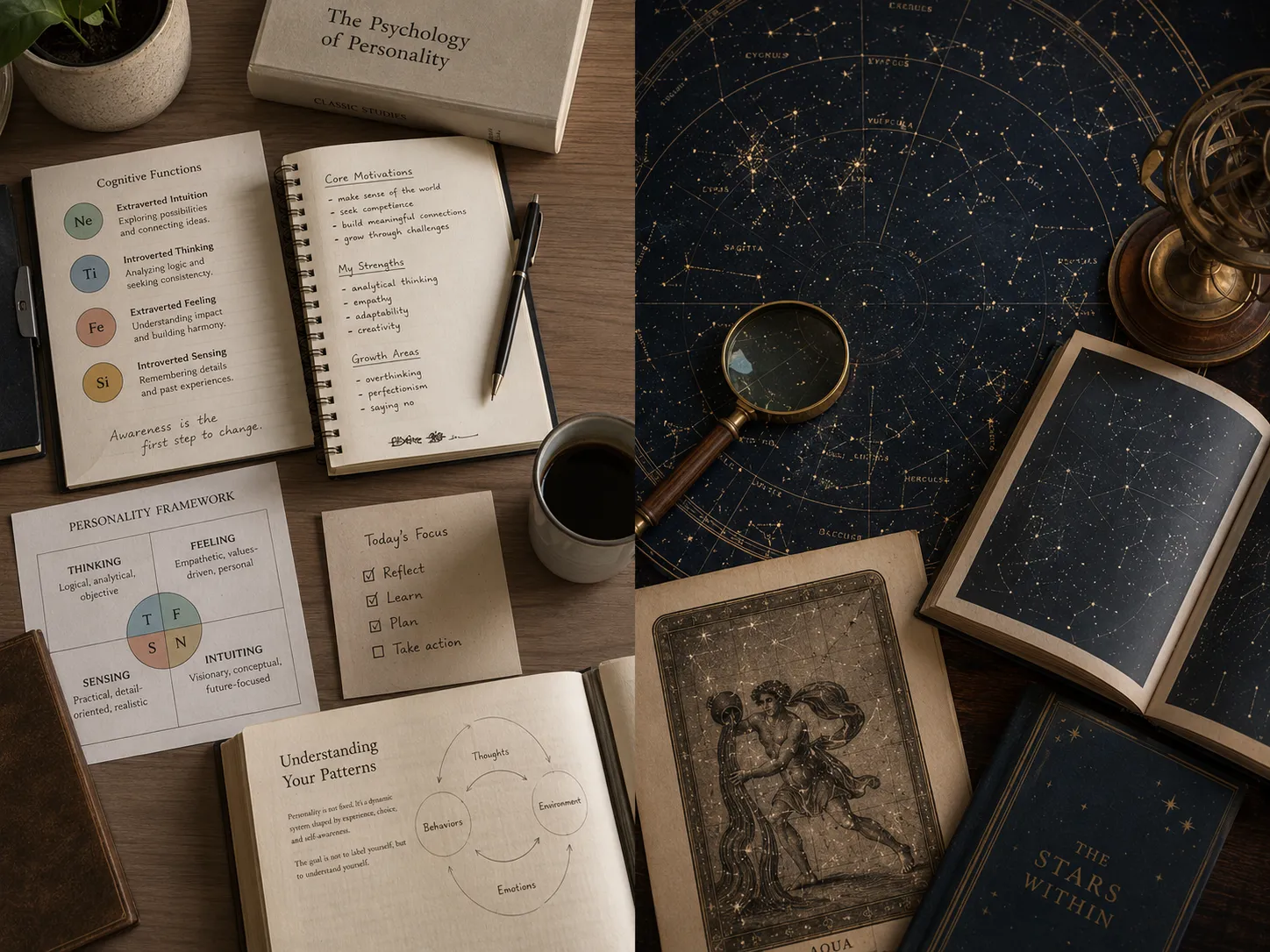
Although zodiac signs and MBTI types both describe personality patterns, their foundations are fundamentally different.
| MBTI | Zodiac Personality |
|---|---|
| Developed from a psychological theory of personality preferences | Developed from Western astrological traditions and symbolism |
| Identified through answers to an assessment | Traditionally identified from birth information |
| Uses 16 personality types | Uses 12 zodiac signs |
| Focuses on information processing, decisions, energy, and lifestyle preferences | Focuses on symbolic personality archetypes and astrological themes |
| Often used for communication, teamwork, and self-awareness | Often used for symbolic reflection and personal exploration |
| Does not attempt to determine a zodiac sign | Does not reliably determine an MBTI type |
Neither system captures the complete complexity of a person. Both simplify personality into recognizable patterns, while real individuals remain influenced by countless personal and social factors.
Can Your Zodiac Sign Predict Your MBTI?
No reliable evidence shows that a zodiac sign can predict an MBTI personality type. Lists that present zodiac signs as MBTI types are creative comparisons rather than proven mappings.
For example, an article may associate Aries with ESTP, Virgo with ISTJ, or Pisces with INFP. These combinations may feel believable because their descriptions share words such as adventurous, organized, or imaginative. However, people born under every zodiac sign can receive any of the 16 MBTI results.
An INTJ Aries, ENFP Capricorn, ISFJ Scorpio, or ENTP Pisces is entirely possible.
Why Some Comparisons Feel Accurate
Both systems use familiar personality language. Traits such as creativity, confidence, empathy, independence, and practicality appear in many descriptions, making similarities easy to notice.
Confirmation bias can also play a role. People naturally remember examples that support an expected pattern and overlook those that do not. That does not make personal reflection meaningless, but it does mean a resemblance should not be mistaken for proof.
Key point: MBTI does not predict zodiac signs, and zodiac signs do not predict MBTI types. Comparisons work best as prompts for discussion and exploration.
Which Is More Accurate?
Instead of asking whether MBTI or zodiac is more accurate, it is more useful to ask what each system is designed to do.
MBTI provides structured language for exploring personality preferences. Zodiac personality uses symbolic traditions to describe archetypal characteristics. Because the two systems have different origins and goals, they cannot be evaluated as though they were identical tools.
Strengths of MBTI
Many people appreciate MBTI because it offers a consistent vocabulary for discussing communication, decision-making, working styles, and personal preferences.
Strengths of Zodiac Personality
Many people enjoy astrology because it is accessible, symbolic, and connected with mythology and cultural tradition. Its value for readers often lies in the questions it inspires rather than in definitive conclusions.
Limitations of Both Systems
Neither MBTI nor zodiac personality can predict every action, guarantee compatibility, define someone’s future, or replace professional psychological support.
Research and professional debate surrounding personality assessments are broader than any single test. The American Psychological Association offers additional context on the validity and use of personality tests.
Why Many People Enjoy Combining MBTI and Zodiac

Combining MBTI and zodiac does not require believing that one proves the other. Many people simply enjoy using them as separate lenses.
MBTI may encourage reflection on communication, information processing, decision-making, and structure. Zodiac personality may encourage reflection on emotional themes, motivation, symbolism, and identity.
Looking at both can inspire useful questions:
- Which description best reflects how I communicate?
- Do I identify with the strengths associated with my zodiac sign?
- Where do my MBTI and zodiac descriptions overlap?
- Where do they contradict each other?
- Which ideas reflect my experience, and which do not?
The WhatZodiac MBTI + Zodiac Calculator brings both systems together for exploration. It is designed as a conversation starter, not as proof that a personality type and zodiac sign are causally connected.
MBTI Compatibility vs Zodiac Compatibility
Compatibility is another area where the two systems are often compared.
MBTI compatibility focuses on how preferences may affect communication, planning, conflict, and decision-making. Zodiac compatibility uses astrological symbolism to consider how signs may complement or challenge one another.
Neither model can determine whether a relationship will succeed. Healthy relationships depend on communication, trust, shared values, emotional maturity, mutual respect, and a willingness to grow.
Personality frameworks can help people discuss differences, but they should never be used to declare that two individuals are destined to succeed or fail.
Frequently Asked Questions
Is MBTI scientifically proven?
MBTI is based on psychological type theory and remains widely known, but researchers continue to debate aspects of its reliability and scientific validity. Many people find it useful for reflection, though it should not be treated as a complete psychological assessment.
Is zodiac personality scientifically proven?
Zodiac personality belongs to the symbolic tradition of astrology rather than an established scientific model of personality. Readers may still value it for cultural interest, storytelling, or personal reflection.
Can your zodiac sign predict your MBTI type?
No. People with the same zodiac sign can have many different MBTI types, and people with the same MBTI type can belong to any zodiac sign.
Can your MBTI type change?
Some people receive consistent results over time, while others receive different results as their circumstances, self-understanding, or answers change. It is generally more useful to treat the result as a description of preferences than as a permanent identity.
Which is more accurate: MBTI or zodiac?
They are difficult to compare directly because they come from different traditions and serve different purposes. MBTI describes personality preferences, while zodiac personality uses astrological symbolism.
Can two people with the same zodiac sign have different MBTI types?
Yes. Sharing a zodiac sign does not mean two people will share the same personality type, behavior, values, or life experience.
Should I choose MBTI or zodiac?
You do not need to choose. Some people prefer the structured language of MBTI, others enjoy astrological symbolism, and many explore both while keeping their limitations in mind.
Final Thoughts
The most useful MBTI vs zodiac comparison is not about declaring a winner. It is about recognizing that the two frameworks approach personality from different directions.
MBTI asks how you tend to process information, make decisions, restore energy, and organize your life. Zodiac personality offers symbolic themes connected with astrological tradition.
Neither four letters nor one Sun sign can fully define you. Human personality is shaped by experience, culture, relationships, values, choices, and change.
Used thoughtfully, however, both frameworks can encourage better questions: What motivates me? How do I communicate? Which strengths do I rely on? Where do I want to grow?

Continue Exploring Your Personality
Use the WhatZodiac tools and guides to continue your self-discovery journey: